Series: Spine, Movement and Pain
Series description: Neuromuscular Mechanisms and Movement Analysis
Category: Body Mechanics & Movement
Subcategory: Trauma & Body
Spine Biomechanics: Segmental Motion and Stability Through Cat–Cow (Part 3)
An in-depth analysis of the Cat–Cow movement in the context of segmental control, low-load stabilization, and spinal biomechanics, explaining why this exercise is more than a simple mobility movement.
Cat–Cow (Marjaryasana–Bitilasana) can be considered a model that organizes segmental spinal flexion–extension under low-load conditions in a quadruped position. When examined as a system targeting segmental control and neuromuscular stability rather than global mobility, this movement gains a function beyond that of a simple exercise.
In modern life, prolonged sitting and reduced movement variability can lead to a decrease in the spine’s segmental motion capacity and a shift toward more global, block-like movement patterns. This condition is associated with neuromuscular adaptations often linked to clinical conditions such as low back pain.
In this article, the Cat–Cow movement is examined in the context of segmental motion control, low-load stabilization, and spinal biomechanics.
1. Segmental Motion and Proprioceptive Control
In the quadruped position, when performed correctly, Cat–Cow is not a global spinal movement but a segmentally distributed articulation pattern. In other words, spinal motion is organized as a wave that begins at the pelvis and is transmitted sequentially from the sacrum to the cervical spine.
- The movement progresses through the lumbar and thoracic segments via sequential intersegmental articulation.
- This transmission reaches the cervical region.
During the flexion phase (Cat), this wave propagates from caudal to cranial, that is, from the tailbone toward the head; during the extension phase (Cow), the same pattern is organized in the opposite direction.
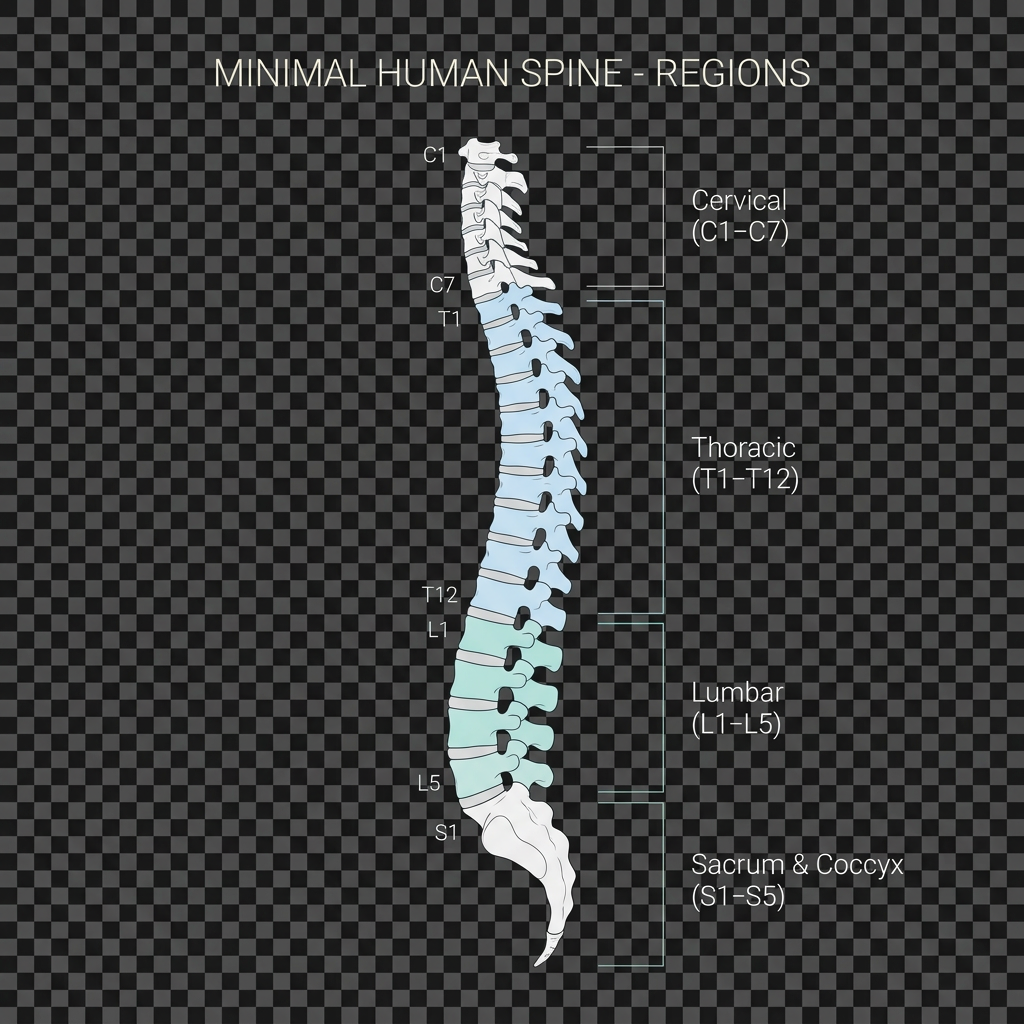
This regional distinction is essential for understanding how movement propagates along the spine during Cat–Cow.
This structure directly parallels the logic of controlled articular rotations (CARs) applied to the spine. The determining factor here is not the magnitude of movement but the resolution of control. Thoracolumbar segments typically exhibit approximately 3–8° of motion per segment; these small angles are biomechanically meaningful.
Similarly, the CARs approach emphasizes controlled and differentiated intersegmental articulation rather than large ranges of motion; quadruped spinal CARs can be considered a practical example of this.
These small movement ranges are not insignificant; on the contrary, they are the fundamental units of spinal control.
From a motor control perspective, Cat–Cow:
- forces the production of differentiated movement between adjacent segments,
- reduces “block movement” strategies,
- aims to re-engage flattened or hypomobile segments.
Therefore, this exercise should not be considered a simple stretch but rather a distributed proprioceptive recalibration task.
2. Stability Under Reduced Axial Load
In the quadruped position—hands and knees on the ground—the load on the spine is significantly reduced compared to standing. This changes the biomechanical nature of the movement.
Stability is the ability of the spine to maintain alignment and remain controlled without collapsing during movement.
In this position, stability is no longer a property carried by bones and passive structures; it becomes dependent on active muscular control. Therefore, Cat–Cow should be understood not only as a mobility exercise but also as a stabilization exercise under low load.
How does this happen?
- Spinal compression decreases, so passive structures carry less load.
- The hamstrings are largely disengaged, allowing greater freedom of movement in the lumbar region.
- Muscles must work together, and stability is actively maintained.
What do the muscles do?
- During flexion (Cat), the abdominal muscles are more active.
- During extension (Cow), the back muscles, especially the erector spinae, become more active.
The key point here is:
Although these muscles work less compared to standing, they activate in a more balanced and coordinated manner.
In other words, the system does not seek maximum contraction but optimal coordination.
Summary:
In Cat–Cow, stability is achieved not through rigidity, but through controlled and balanced muscle activation.
3. Follower Load: Aligning and Supporting the Spine Through Muscle Activity
The spine is not merely a passive structure made of bones. The primary factor that keeps it stable during movement is the force generated by muscles.
This is where the concept of follower load comes into play.
Follower load is not the application of a downward compressive force on the spine, but rather the production of force along the natural curvature of the spine to maintain segmental alignment.
What does this mean?
- When a load presses directly downward, the spine compresses, and bending and shear forces increase.
- When muscles function properly, force is directed along the curvature of the spine.
- Segments align, and unnecessary loading is reduced.
Why is it important in Cat–Cow?
- Axial load is low in the quadruped position.
- However, the spine is not completely unloaded.
- Stability is achieved not by compressing the spine, but by aligning and supporting it.
How does this system work?
- Deep muscles, especially multifidus, stabilize spinal segments at a micro level.
- The abdominal muscles regulate pressure.
- The system works as a whole to maintain spinal balance.
Summary:
Follower load is not about compressing the spine, but about supporting it through alignment.
Stability: The capacity of the spine to maintain alignment during movement.
Follower Load: The mechanism by which this stability is achieved through muscle-generated forces following the spinal curvature.
4. Spinal Biomechanics: Flexion–Extension Cycle
The Cat–Cow movement primarily occurs in the sagittal plane, meaning a forward–backward motion. However, during this movement, the load distribution across the spine continuously changes.
4.1. Flexion phase (Cat)
- The anterior part of the disc experiences increased pressure.
- Posterior connective tissues are stretched.
- Back muscles lengthen under control (eccentric contraction).
4.2. Extension phase (Cow)
- The load shifts to posterior structures, especially facet joints.
- Pressure on the anterior disc decreases.
- Back muscles shorten (concentric contraction).
What do these two phases create together?
A cyclical loading pattern in which the load does not remain in one place but shifts throughout the movement.
Why is this important?
- It enhances fluid movement within the disc.
- It supports disc nutrition through diffusion.
- It counteracts the negative effects of prolonged static postures.
In simple terms:
The spine behaves like a low-intensity “pump.” As it moves, fluid circulates, helping maintain tissue vitality.
What do we observe clinically?
In yoga and similar movement practices, flexion–extension patterns have been shown to increase range of motion and reduce pain-related functional limitations.
Why do these effects occur?
- low-intensity but repetitive load variation,
- improved neuromuscular coordination,
- restoration of segmental movement variability.
5. Conclusion (Part 3)
Cat–Cow is often considered a simple mobility exercise. However, this perspective is incomplete. This movement not only produces motion in the spine but also determines how that motion is organized.
Cat–Cow:
- teaches segmental control of the spine,
- enables stability under low load,
- facilitates balanced load distribution along the spine.
Therefore, what matters is not the range of motion, but the quality of movement.
When performed with segmental awareness, Cat–Cow ceases to be a simple exercise and becomes a system that develops control, coordination, and adaptation.
References
Academic source
Valentin, S., & Licka, T. F. (2016). Spinal Motion and Muscle Activity during Active Trunk Movements – Comparing Sheep and Humans Adopting Upright and Quadrupedal Postures. PLOS ONE, 11(1), e0146362.
https://doi.org/10.1371/journal.pone.0146362
Supplementary source
Lee, C. (2018, July 26). Quadruped Spinal CARs. PhysioStrength NYC.
https://physiostrengthnyc.com/blog/2018/11/22/quadruped-spinal-cars