Series: Spine, Movement and Pain
Series description: Neuromuscular Mechanisms and Movement Analysis
Category: Body Mechanics & Movement
Subcategory: Trauma & Body
Cat–Cow Exercise: Movement Mechanics and Muscle Activation (Part 1)
An introductory analysis explaining why the body becomes stiff over time; how this is related not only to muscles, but also to movement organization and the nervous system, through the Cat–Cow exercise.
Do you notice your back becoming stiff after sitting for long periods? Does your spine feel less mobile when you wake up in the morning?
This condition is often explained simply as “muscle tightness.” However, the underlying mechanism is more complex. The issue is not only the state of the muscles, but how the body organizes movement.
1. The Body Does Not Stay Silent
The human body is not passive in the face of acute stress, chronic loading, sports injuries, or prolonged psychophysiological tension. It responds at the neuromuscular level, often manifesting as increased muscle tone, restricted movement, and postural changes.
This process is not purely physical. There is a continuous bidirectional communication between the central nervous system and the musculoskeletal system. While the brain regulates muscle activation and movement patterns, muscles, joints, and connective tissues constantly send sensory feedback to the brain.
Therefore, stress does not remain only a mental state; over time, it becomes physically organized and leaves a somatic imprint on the body.
2. How Protective Mechanisms Create Problems
In acute situations, this response is adaptive. Muscle contraction, movement restriction, and increased stability serve to protect the body.
However, when this state becomes chronic, these protective mechanisms lose their function and turn into dysfunction.
At this stage:
- some muscles remain constantly active,
- others become inhibited,
- movement patterns deteriorate,
- the spine begins to lose its segmental mobility.
The problem is no longer a single muscle, but the organization of movement itself.
3. How Stiffness Becomes a Cycle
This condition often evolves into a cycle:
Movement decreases → stiffness increases → pain develops → movement decreases further
Modern lifestyle accelerates this cycle:
- prolonged sitting,
- repetitive and limited movement patterns,
- low movement variability,
- chronic stress load.
As a result, the body gradually becomes more rigid instead of remaining a dynamic system.
4. The Real Problem: Not the Muscle, but Movement Itself
At this point, an important distinction emerges: the problem cannot be solved simply by strengthening or stretching muscles.
Because the issue is often not muscle weakness or tightness, but the disruption of movement organization itself.
In other words, the problem is more related to motor control deficiency than lack of strength.
The body can no longer distribute movement efficiently; some areas become overloaded while others are underused.
5. Cat–Cow: Relearning Movement
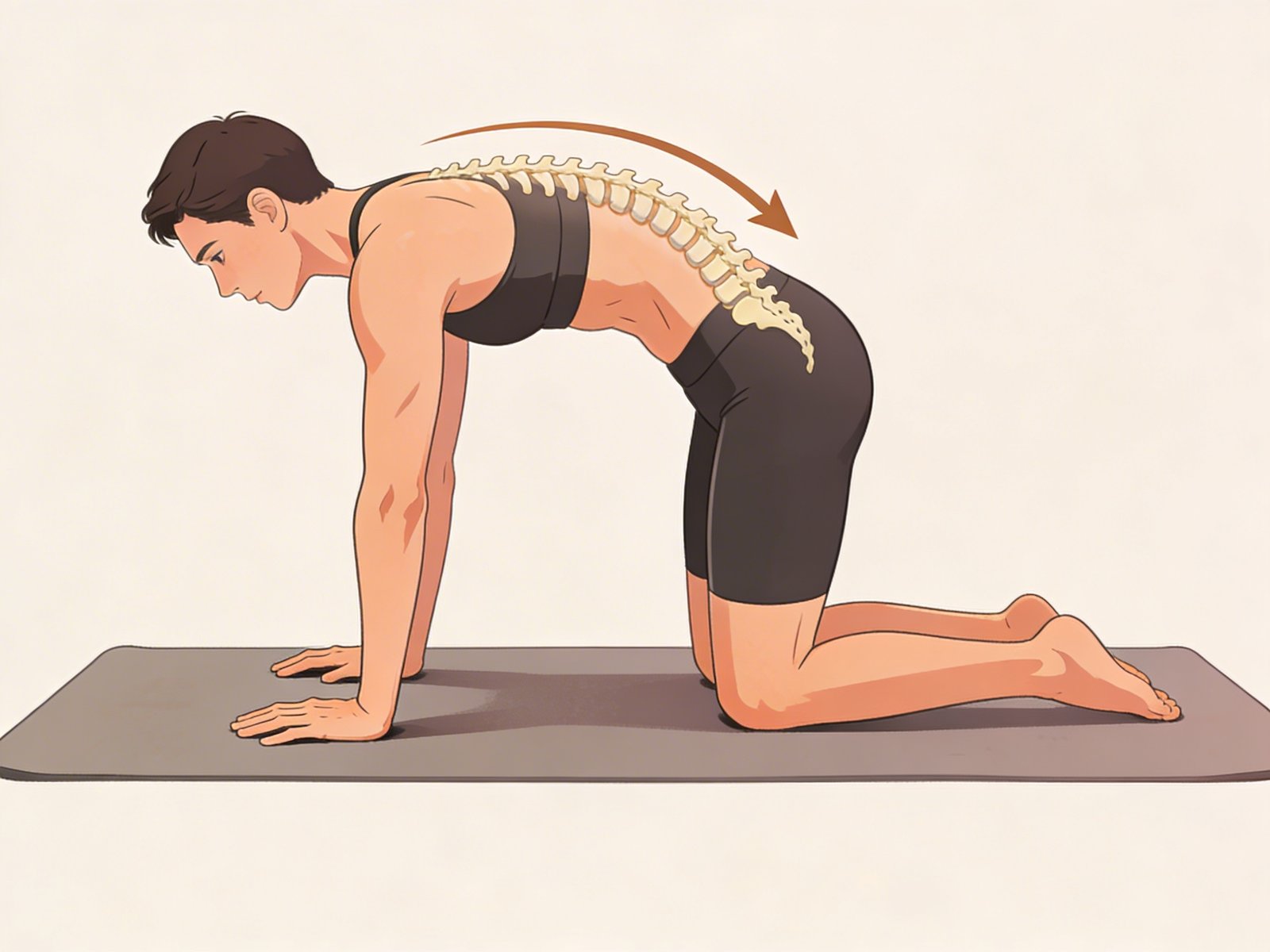
Cat phase – controlled spinal flexion.
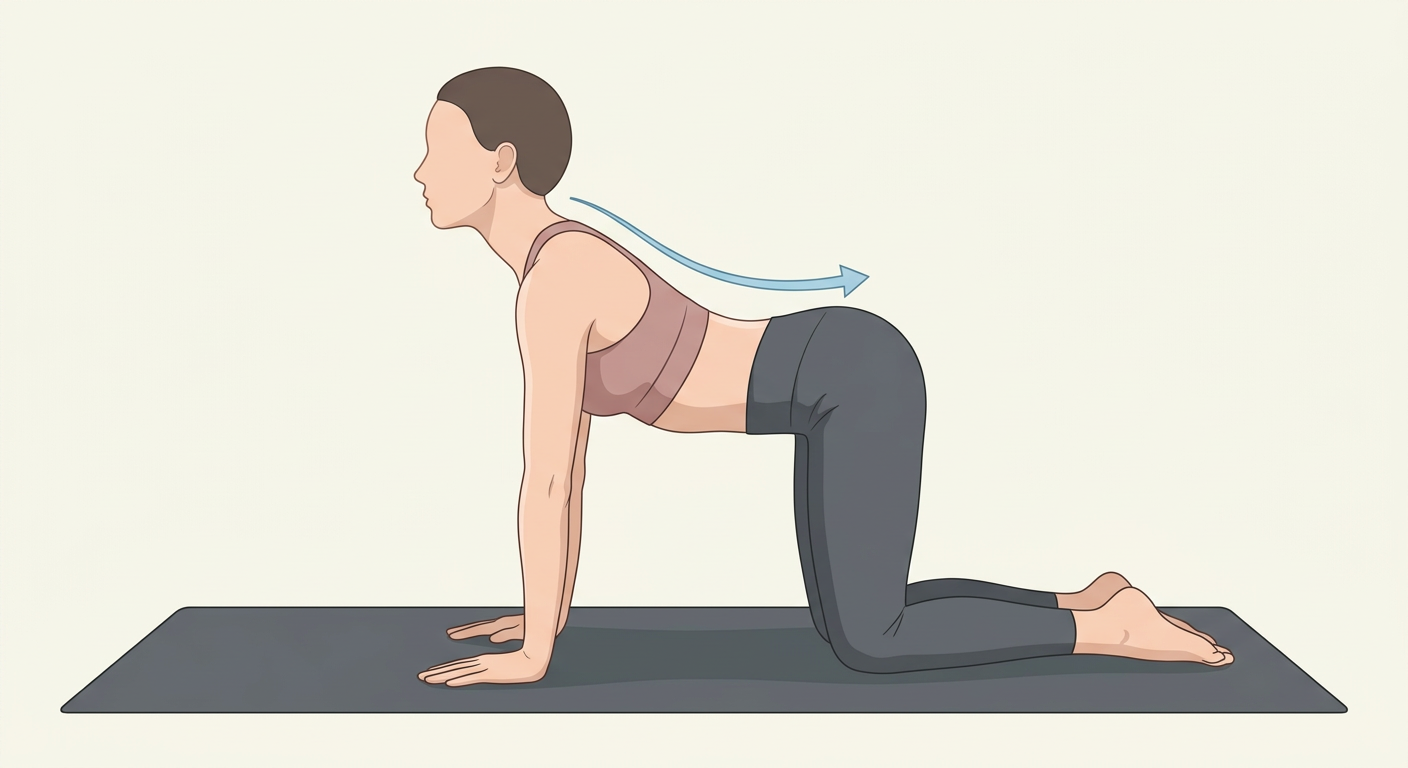
Cow phase – controlled spinal extension and alignment.
The Cat–Cow exercise directly targets this problem.
At first glance, it may appear as a simple stretch. However, it actually aims to restore segmental mobility and improve coordination between muscle groups by moving the spine in a controlled manner between flexion and extension.
- the spine begins to move segment by segment rather than as a single unit,
- deep stabilizing muscles (especially multifidus and transversus abdominis) are activated,
- a balance between superficial and deep muscles is re-established.
Additionally, when synchronized with breathing, the movement has not only mechanical effects but also regulatory effects on the autonomic nervous system.
- muscle tone decreases,
- tension begins to resolve,
- movement becomes more fluid.
Therefore, Cat–Cow is not just a mobility exercise, but a fundamental transitional movement that helps the body relearn how to move.
6. How to Perform the Cat–Cow Movement
The Cat–Cow exercise aims to move the spine in a controlled manner between flexion and extension. Therefore, correctness depends on control rather than speed.
6.1. Starting Position (Neutral Setup)
- Hands should be directly under the shoulders.
- Knees should be under the hips.
- The spine should remain in a neutral position.
- The neck should align with the spine.
- The core should be lightly engaged.
This position is called quadruped and provides a stable base.
6.2. Cow Position — Extension
- The movement begins with inhalation.
- The pelvis tilts upward.
- The lower back gently arches.
- The chest opens forward and upward.
- The shoulders remain relaxed.
- The gaze moves slightly forward.
The goal is controlled spinal extension.
6.3. Cat Position — Flexion
- The movement reverses with exhalation.
- The pelvis tilts inward.
- The abdomen draws inward.
- The spine rounds upward.
- The chin moves toward the chest.
The goal is controlled spinal flexion.
6.4. Movement Rhythm
- The movement should be slow and fluid.
- Transitions should be continuous.
- It should be synchronized with breathing:
- Cow → inhale
- Cat → exhale
This synchronization is critical for nervous system regulation.
7. Key Point: How Should the Movement Feel?
- The focus should be on movement, not pain.
- The spine should move segment by segment.
- The movement should not be concentrated only in the lower back.
If only the lower back moves, this is typically a compensation pattern.
8. Common Mistakes
1. Moving only from the lower back
- The thoracic spine does not engage.
- The effectiveness decreases.
2. Moving too fast
- Neuromuscular benefits decrease.
3. Holding the breath
- The regulatory effect on the nervous system is reduced.
4. Tension in the shoulders
- Neck and upper trapezius are unnecessarily activated.
5. Overexertion
- This is a mobility exercise, not a performance movement.
9. How Much Should It Be Done?
- 8–12 repetitions
- 2–3 sets
- slow and controlled execution
Particularly effective in the morning or after prolonged sitting.
Short version:
The Cat–Cow exercise improves spinal mobility and coordination by moving the spine between flexion and extension in synchronization with breathing.
10. Which Muscle Groups Are Involved?
- Erector spinae
- Rectus abdominis
- Transversus abdominis
- Multifidus
- Gluteus maximus
- Scapular stabilizers
11. Muscle Activation and Movement Mechanics
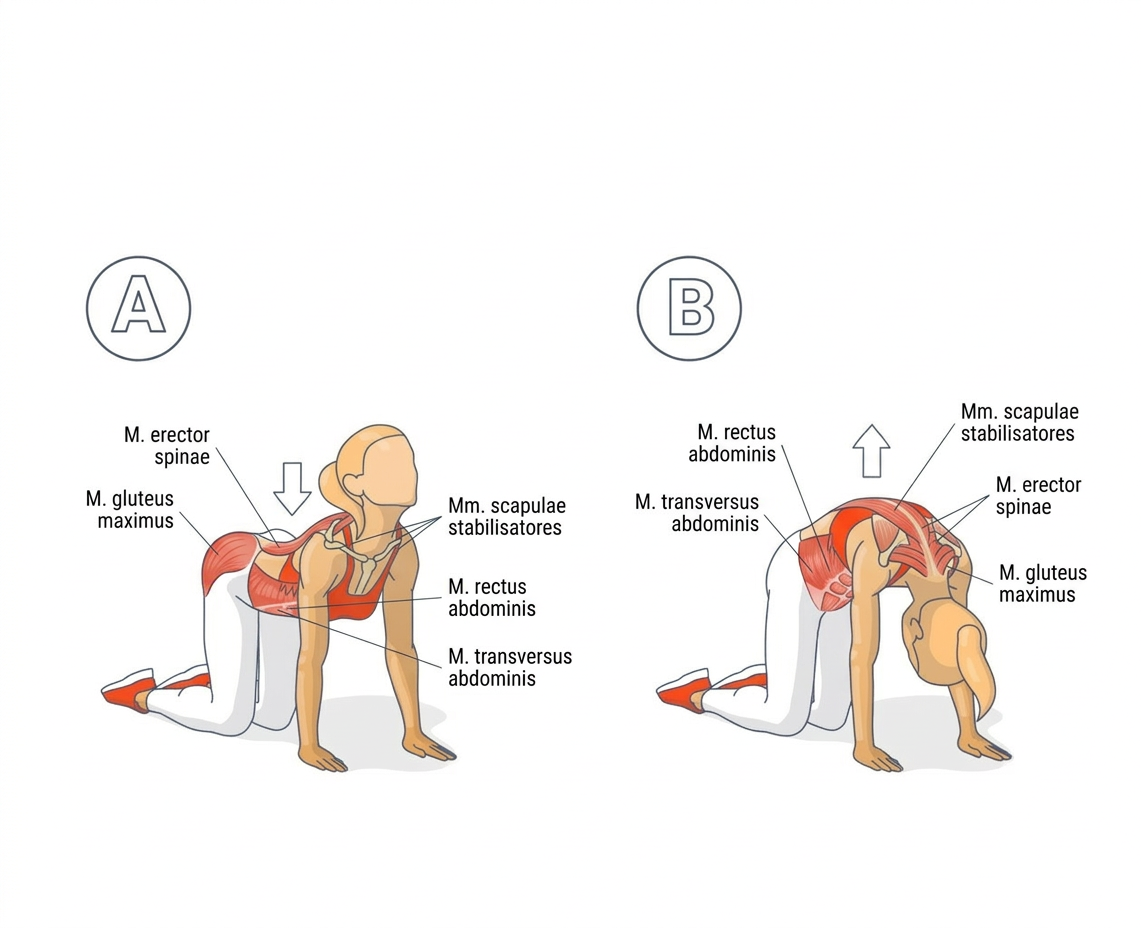
The diagram above shows the two main phases of the Cat–Cow movement.
- A (Cow – extension): Erector spinae and scapular stabilizers are more active.
- B (Cat – flexion): Rectus abdominis and transversus abdominis are more active.
12. Conclusion (Part 1)
Body stiffness is not merely a muscle problem, but a disruption in movement organization and neuromuscular balance.
The Cat–Cow exercise plays a key role by teaching the body how to move again rather than forcing it.
In the next part of this series, the relationship between Cat–Cow, pain, posture, and clinical applications will be explored in more detail.