Series: Spine, Movement and Pain
Series description: Neuromuscular Mechanisms and Movement Analysis
Category: Body Mechanics & Movement
Subcategory: Trauma & Body
Cat–Cow Exercise: Pain, Posture and Clinical Applications (Part 2)
An applied analysis of when the Cat–Cow exercise is effective, which types of pain it addresses, and in which situations it should not be the first approach.
The Cat–Cow exercise is not a universal solution for every type of pain. Its effectiveness depends largely on the underlying mechanism of the condition.
In most cases, it works best in situations characterized by reduced mobility, prolonged inactivity, and impaired motor control.
Therefore, the key question is not “Does this exercise work?” but rather: In which conditions does it actually make sense to use it?
1. When Is Cat–Cow Recommended?
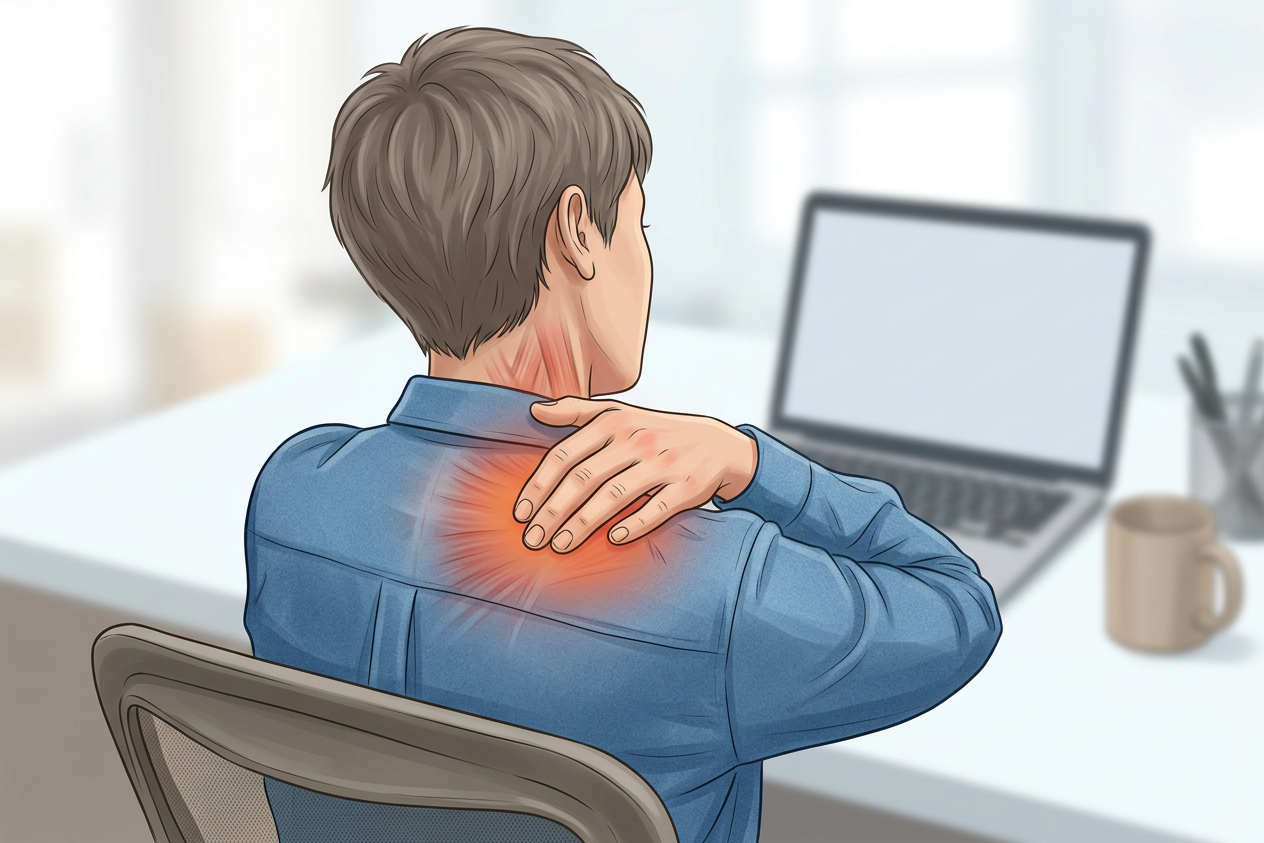
Example of postural loading related to neck and upper back pain.

Example of mechanical low back pain associated with prolonged static loading.
The Cat–Cow exercise is particularly effective in conditions involving:
- reduced spinal mobility,
- prolonged inactivity,
- segmental movement loss,
- motor control impairment,
- postural loading patterns.
These conditions typically share a common characteristic: pain tends to decrease with movement and increase with inactivity.
2. Non-specific Low Back Pain
One of the most common indications for Cat–Cow is non-specific low back pain.
Typical characteristics include:
- pain after prolonged sitting,
- symptoms improving with movement,
- a sensation of stiffness or restriction.
In these cases, the issue is usually not structural damage but rather reduced movement variability and muscular imbalance.
Cat–Cow contributes by:
- improving spinal mobility,
- activating deep stabilizing muscles,
- restoring segmental motion.
3. Morning Stiffness and Limited Mobility
Morning stiffness is often experienced as a “locked” or restricted feeling in the spine, especially during the first movements of the day.
This is commonly related to:
- prolonged immobility during sleep,
- reduced circulation,
- delayed neuromuscular activation.
Cat–Cow helps reintroduce controlled movement, gradually activating spinal segments and preparing the body for functional activity.
4. Posture-Related Pain
Modern lifestyles often lead to repetitive and static postural patterns.
Common in:
- desk workers,
- frequent phone users,
- individuals with prolonged screen exposure.
Affected regions typically include:
- thoracic spine,
- cervico-thoracic junction,
- lumbar region.
Cat–Cow introduces movement variability and helps redistribute mechanical load across the spine.
5. Neck and Upper Back Tension
In many cases, neck and upper back tension is not purely muscular but also involves the nervous system.
Common symptoms include:
- persistent tightness,
- heaviness in the shoulders,
- stress-related muscle tension.
The rhythmic and breath-synchronized nature of Cat–Cow may help reduce muscle tone and promote parasympathetic activity.
6. Low-Level Mechanical Loading
Cat–Cow may also be beneficial in cases of low-grade mechanical loading caused by:
- prolonged standing,
- improper lifting mechanics,
- repetitive movements.
In these situations, the exercise helps redistribute load and reduce static pressure on spinal structures.
7. Not Suitable for Every Type of Pain
The effectiveness of Cat–Cow depends on the underlying condition. It is not appropriate as a first-line approach in all cases.
Use caution or seek clinical evaluation in cases such as:
- acute trauma,
- severe disc herniation with nerve compression,
- numbness, tingling, or muscle weakness,
- active inflammatory conditions.
8. Conclusion (Part 2)
The Cat–Cow exercise is most effective in conditions involving movement restriction, reduced mobility, and postural loading.
Rather than forcing the body, it facilitates the reorganization of movement and restores functional variability.
The goal is not to push the body harder, but to help it move better.
In the next part of this series, we will explore spinal biomechanics, segmental movement, and stability in greater depth.